Seeing Green After Acrylics? What You Need to Know
What Causes Green Nails?
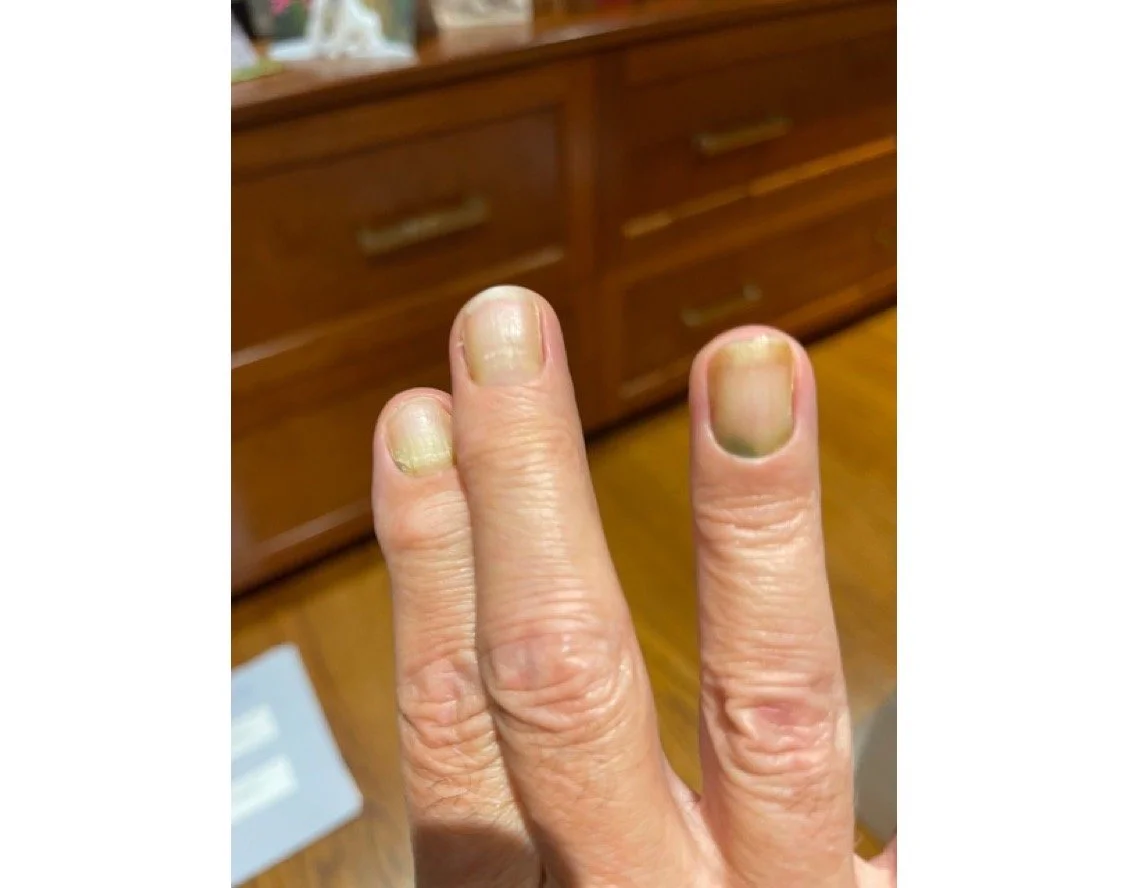
You remove an acrylic, gel, dip, or press-on nail and discover an alarming green spot underneath. Your first thought may be nail fungus but a distinctly green nail after artificial nails is often caused by something else: a bacteria called Pseudomonas aeruginosa.
The condition is commonly called green nail syndrome. Salons call it “the greenies.” Covering it with another artificial nail or assuming it will simply grow out can allow the problem to persist and potentially worsen.
The clinical appearance can vary. Depending on the concentration of pigment and the thickness of the nail, the affected area may appear light green, yellowish, blue-green, dark green or almost black.
Understanding why the nail turned green is the first step toward treating it correctly.
Why Did My Nail Turn Green?
The acrylic itself does not normally turn the natural nail green. The problem generally begins when part of the artificial nail lifts away from the natural nail plate. That small space can trap water, debris and microorganisms. Because the area is warm, moist, and sealed beneath an artificial enhancement, it creates an ideal environment for Pseudomonas bacteria to grow. Interestingly, the bacteria produces pigments that can stain the nail. Pyocyanin produces a blue-green color and Pyoverdine a yellow-green color. This pigmentation is very telling and distinguishes Pseudomonas from other organisms. Green discoloration is especially likely when an acrylic, gel or press-on nail has lifted but remains in lace. Water may enter the space during handwashing, showering, swimming, or cleaning and become trapped underneath.
Is a Green Nail Always Pseudomonas?
A clearly green nail is highly suggestive of Pseudomonas, but color alone cannot confirm every diagnosis. Other nail problems that can produce discoloration include fungal infections, trauma and dried blood beneath the nail, or staining from polish or chemicals. Importantly, a green nail should not be treated with over-the-counter antifungal medications.
Why Artificial Nails Increase the Risk
Artificial nails can create several conditions that make green nail syndrome more likely. First, the natural nail may become thinner or damaged during preparation, filing, removal, or repeated manicures. Trauma can weaken the bond between the nail plate and nail bed, allowing the nail to lift. Second, acrylics and other enhancements can conceal early separation. The lifting may not be visible until the artificial product is removed. Third, even a microscopic gap can trap moisture. Applying glue or additional product over a lifted nail may seal that moisture inside. The risk may be higher with:
Repeated acrylic, gel, dip or press-on manicures
Artificial nails that have begun lifting
Aggressive filing or drilling of the natural nails
Improper removal
Frequent exposure to water
Work involving wet hands
Reapplying product over a damaged or discolored nail
This does not mean that everyone who wears artificial nails will develp a bacterial problem. It means that lifting, trauma, and retained moisture shoudl be addressed promptly.
Is Green Nail Syndrome Contagious?
Green nail syndrome is not generally considered contagious in the same way as a cold or flu. Pseudomonas requires a favorable environment to grow. A lifted nail or a nail with a gap where moisture can collect is the ideal environment. If you have Pseudomonas, be sure not to use the same tools on your uninfected nails and don’t re-use disposable items. In fact, you should take a break from nail cosmetics while treating.
A Rare but Serious Concern for Contact Lens Wearers
Green nail syndrome usually remaines localized to the nail. However, a published medical case illustrates why the condition should not always be dismissed as a harmless stain. In a case report published in Pediatric Dermatology, a teenage girl who had applied artificial nails at home developed extensive green nail syndrome. She also presented with a serious Pseudomonas infection of the cornea in her left eye, known as pseudomonal keratitis, which caused a corneal ulcer. Later medical literature discussing the case describes persistent corneal scarring.
The available report does not prove precisely how the bacteria reached the eye, so it would be inaccurate to state with certainty that she transferred it directly from her nail to a contact lens. Nevertheless, the case raises an important concern: handling contact lenses or touching the eyes with an affected finger may provide an opportunity for bacteria around the nail to reach the eye.
This was an unusual complication, not the expected outcome of an ordinary green nail. But Pseudomonas keratitis can be vision-threatening and requires urgent treatment.
If you wear contact lenses and develop a green nail:
Avoid handling lenses with the affected finger. You may want to avoid lenses entirely until the nail is clear.
Wash and dry your hands thoroughly before touching your eyes.
Do not touch or rub your eyes unnecessarily.
Follow proper contact-lens cleaning and replacement instructions.
Seek urgent eye care for redness, pain, discharge, light sensitivity, blurred vision, or any change in vision.
The case, reported by physicians at Baylor College of Medicine and Texas Children’s Hospital, is titled “Green nail syndrome complicated by pseudomonal keratitis in a teenager with artificial nails.”
What Should You Do When You Find a Green Nail?
The first step is to remove the artificial product so the natural nail can be evaluated. Do not place a new acrylic, gel, dip coating, or press-on nail over the discoloration.
Keep the nail short, clean, and as dry as possible. Avoid digging beneath it, scraping away attached nail, or aggressively buffing the green area. These actions can cause additional separation and trauma.
Do not share nail tools, and disinfect reusable instruments according to the manufacturer’s directions.
You should also pause polish and artificial nail use until the cause is understood and the nail has recovered. Covering the nail may hide progression and recreate the moist, occlusive conditions that allowed the bacteria to grow.
Can I Treat a Green Nail at Home?
Online advice frequently recommends vinegar soaks or other home remedies. Dilute acetic acid can be very effective at inhibiting Pseudomonas but often a prescription topical antibiotic is also needed.
The concentration, frequency, condition of the surrounding skin, degree of nail separation, and possibility of a mixed infection all matter. Strong or improperly diluted solutions can irritate the skin and worsen an already damaged nail barrier. Dr. Stern generally recommends a 50% dilution.
A clinician may recommend drying measures, trimming detached nail, topical treatment, testing, or—in selected cases—prescription medication. The correct approach depends on the severity of the condition and whether another nail disorder is present.
Avoid using leftover antibiotic drops or another person’s medication. Certain antibiotics do not cover Pseudomonas.
When Should You See A Dermatologist?
Consider a professional evaluation if:
You are unsure whether the discoloration is bacterial, fungal, or traumatic.
The green area is spreading or becoming darker.
More than one nail is affected.
The nail is painful, swollen, warm, or draining.
The surrounding skin is red or inflamed.
The nail is significantly lifted or damaged.
The problem keeps returning after artificial nails.
You have diabetes, poor circulation, or a weakened immune system.
Previous antifungal or home treatment has not worked.
You wear contact lenses and are concerned about handling them safely.
Seek urgent medical attention for rapidly increasing pain, redness spreading beyond the nail, fever, or other signs of a more serious infection.
Eye pain, redness, light sensitivity, discharge, blurred vision, or reduced vision requires urgent eye evaluation—especially in a contact lens wearer.
How Long Does The Green Color Take to Go Away?
Even after the bacterial overgrowth has been controlled, the green pigment may remain in the nail plate. The discoloration often has to grow out with the nail.
Fingernails grow approximately three millimeters per month, although growth varies with age, health, season, and the individual nail. A complete fingernail can take four to six months to replace itself, and damaged nails may take longer to appear normal.
Persistent color does not always mean the infection is still active. Conversely, improvement in color does not prove that an underlying lifting or fungal problem has resolved. Monitoring how the new nail grows can provide useful information.Fingernails grow approximately three millimeters per month, although growth varies with age, health, season, and the individual nail. A complete fingernail can take four to six months to replace itself, and damaged nails may take longer to appear normal.
Persistent color does not always mean the infection is still active. Conversely, improvement in color does not prove that an underlying lifting or fungal problem has resolved. Monitoring how the new nail grows can provide useful information.
How Can You Prevent Green Nails After Acrylics?
Prevention focuses on avoiding trauma, lifting, and trapped moisture.
Remove or repair an artificial nail promptly if it begins to lift.
Never glue down a lifted enhancement without evaluating the natural nail.
Do not cover a green or otherwise abnormal nail with new product.
Avoid aggressive filing of the natural nail plate.
Have artificial nails removed carefully rather than peeling them off.
Keep nails dry when possible.
Wear gloves for prolonged cleaning or wet work.
Allow damaged nails time to recover before reapplying enhancements.
Use properly disinfected manicure instruments.
Do not share files, buffers, or clippers.
Examine natural nails between artificial-nail applications.
If green discoloration repeatedly returns, the issue may be more than a salon-related stain. Chronic onycholysis, inflammatory nail disease, fungus, trauma, or another underlying condition may be maintaining the space where bacteria grow.Yellow Nail Syndrome is uncommon but should be considered when yellow nails occur together with markedly slow nail growth and characteristic nail changes.
The Bottom Line
A green nail after acrylics is often caused by Pseudomonas, not fungus. The bacteria thrive when moisture becomes trapped between a lifted artificial nail and the natural nail plate.
Most cases remain localized and can be managed successfully once the enhancement is removed and the correct diagnosis is made. However, the nail should not simply be covered again or repeatedly treated as fungus without confirmation.
The rare report of pseudomonal keratitis in a teenager with artificial nails also provides an important reminder for contact lens wearers: practice meticulous hand hygiene and avoid handling lenses with an affected finger.
If your nail is green, lifting, painful, recurring, or failing to improve, a virtual nail consultation can help distinguish bacterial colonization from fungus, trauma, and other nail conditions and determine the most appropriate next step.Treatment depends entirely on the underlying cause.