Hot flashes, sleep changes, thinning hair and dry skin are well-known signs of menopause. But there is another part of the body that can change during this hormonal transition that gets far less attention: your nails.
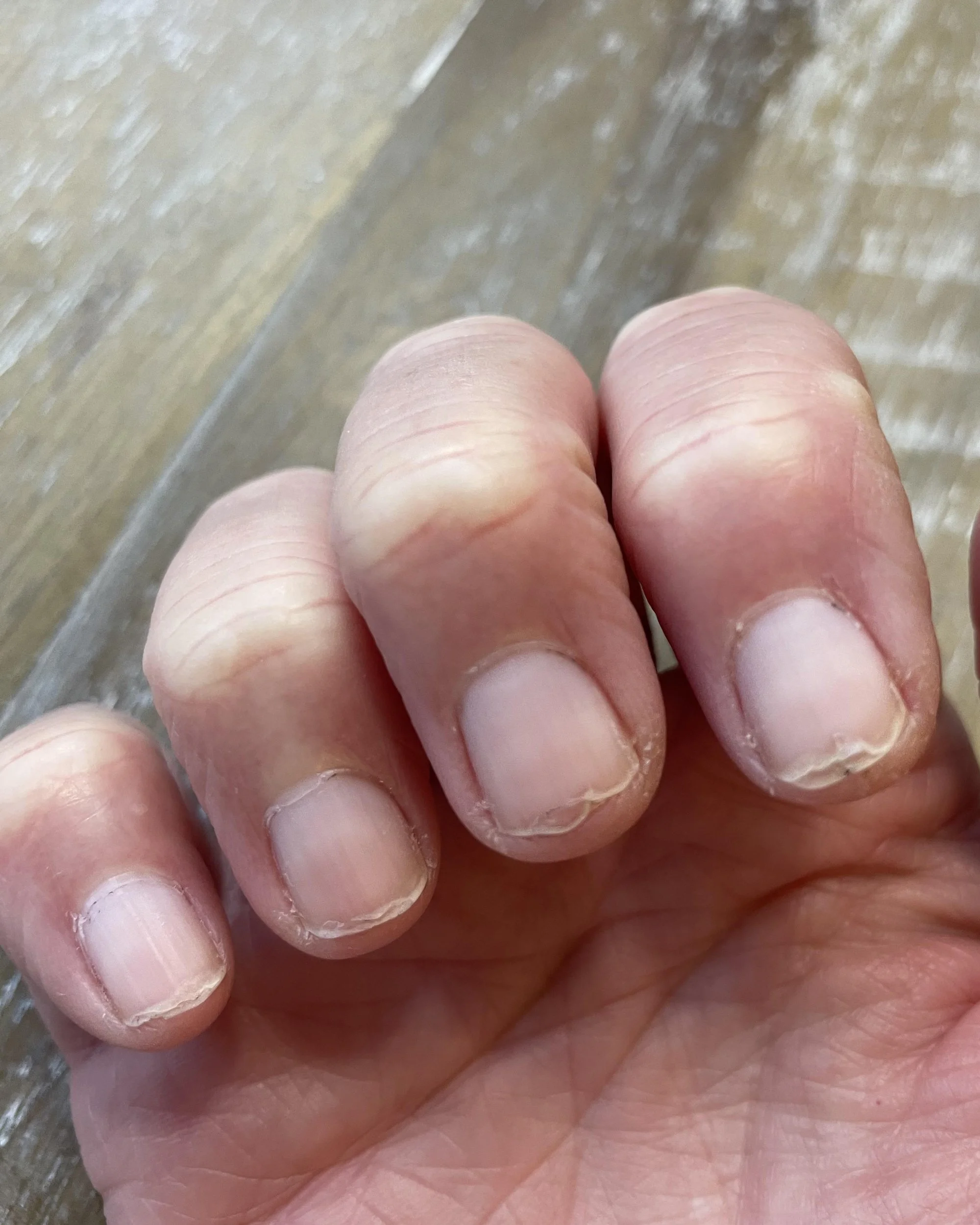
Many women notice that their nails suddenly seem drier, more brittle or prone to peeling and splittng during perimenopause and menopause. Others notice more prominent ridges or simply that their nails dont seem to grow the way they used to.
These changes aren’t necessarily your imagination. There is some fascinating science behind what happens to our nails as estrogen levels decline and we age.
Your Nails Contain Lipids, Too
We tend to think of nails as simply being made of keratin, but the nail plate is more complex than that. It also contains small amounts of water, lipids, or fats, that contribute to its physical properties.
Think of these lipids as part of the nail’s natural conditioning system. Although they make up only a tiny fraction of the nail plate, they help contribute to the nail’s flexibility and ability to withstand everyday stresses.
Research has show that the lipid compostion of the nail changes with both age and sex. In fact, researchers studing healthy fingernails found distinct differenes between the lipid profiles seen during women’s reproductive years and those seen later in life. This suggests that sex hormones play a role in nail lipid production. One lipid that is particularly interesting is cholesterol sulfate. In a study of health adults ranging in age from 20 to 92, cholesterol sulfate levels in the nail decreased significantly with age in women. Researchers proposed that this loss could be one reason brittle nails become increasingly common as women get older. The hormonal changes of menopause may affect more than the moisture level of your skin and may also change the internal composition of the nail itself.
Why Does Losing Nail Lipid Matter?
A healthy nail needs to be strong but it also needs to have some flexibility. When nails become less flexible, everyday activities such as washing dishes, removing polish, typing, opening packages or simply repeatedly wetting and drying the hands can create tiny stresses within the nail plate. Instead of bending, the nail may begin to split, peel or break. This helps explain some of the changes women commonly describe around menopause:
Nails that break more easily
Peeling or splitting at the tips
Increased longitudinal ridging
Nails that feel dry or rough
Difficulty growing nails as long as they once could
Slower nail growth
And brittle nails do become more common with age. Published data have found brittle nails in approximately 19% of people under age 60 compared with 35% of those over 60.
There’s Another Factor: Blood Flow
Our peripheral circulation also changes as we age. The nail matrix, the area where the nail is produced, depends upon an adequate blood supply to deliver oxygen and nutrients to the cells responsible for creating the nail. Reduced circulation to our fingers and toes is one of several factors thought to contribute to age-related nail changes. This is also why even in young kids who wear tight casts brittle nails have been observed to develop in the casted hand. We believe that the nail’s estrogen receptors are located in the nail matrix. And it turns out that studies have shown that postmenopausal nail capillary blood flow is reduced and interestingly, improves with hormone replacement. In fact, a 20-30% increased blood flow was restored by hormone replacement.
Your Nails Really Do Grow More Slowly as You Age
This isn’t just a perception. Nail growth has been studied for decades, and researchers have consistently demonstrated that it slows with age. One classic study found that the rate of nail growth decreases by approximately 50% across the human lifespan. In another remarkable study, a physician tracked his own nail growth for 35 years. His thumbnail grew approximately 0.123 millimeters per day at age 32, compared with 0.095 millimeters per day at age 67.
When nails grow more slowly, damage takes longer to grow out. A split, ridge or area of trauma that might once have disappeared relatively quickly can remain visible for months. Slower growing toenails may also be more vulnerable to problems such as fungal infection because the nail isn’t replacing itself as rapidly.
So Is Menopause or Aging to Blame?
Probably both. Menopause and aging happen simultaneously, which makes it difficult to separate their effects completely. The available research suggests that hormonal changes impair the matrix keratinocytes ie. the nail building blocks. Coupled with decreased blood flow, and slower nail growth, these changes can create a nail that behaves very differently at 55 than it did at 35.
What Can You Do About Menopausal Nails?
The goal is to protect the nail’s barrier and minimize the everyday stresses that make brittle nails worse.
Moisturize the nail and cuticle with oils or ointments which absorb better than creams. Massaging into the cuticle several times per day will also help peripheral circulation, an added bonus.
Minimize prolonged water exposure. Wear gloves with wet-work cotton under rubber is preferred.
Avoid aggressive manicures that include scraping, prolonged acetone soaks and excessive buffing.
Keep nails short and use a glass file to smooth edges.
If your nails become brittle suddenly, see your physician to explore potential internal causes such as thyroid or anemia.
If you are having several hormone induced symptoms, discuss whether hormone replacement therapy is right for you